Egg Farm funding: what’s still unanswered
In an Oct. 19 response, Utah County says the redevelopment agency must notify it when a cap requires early termination. The Ledger is still seeking the records needed to explain how American Fork's Egg Farm receipts were counted against the cap.
Updated, Oct. 19, 2026: what changed ↓
Continuing story: Auditing American Fork
Utah County says American Fork's redevelopment agency is responsible for telling it when a tax-increment cap requires collections to stop early. The county's Oct. 19 response clarifies that responsibility but leaves the central Egg Farm question unanswered: how much of the money paid to the agency counts toward its $9,262,291 limit?
The agency's own reports say only $213,198 remained under the cap after tax year 2022, then list $3,279,538 in receipts for 2023 through 2025. The numbers don’t yet tell the full story. We’re still seeking the records needed to explain how the receipts were counted against the cap and reconcile the cumulative total behind that remaining-cap figure. [6]
What Utah County said
Burt Harvey, a tax administration analyst in the Utah County Auditor's Office, told The Ledger in an Oct. 19 email that the office calculates and distributes property tax increment each year. He said the distribution timeline is governed by state law and agreements between the redevelopment agency and participating taxing entities.
If a cap requires an early stop, Harvey said, the agency must notify the county. Otherwise, the county continues distributing increment until the termination tax year in the agreement. If an agency receives more than its governing documents allow, he said, it must return the excess directly to the taxing entities or to the county for redistribution.
Harvey directed governing-document questions to the American Fork Redevelopment Agency and payment questions to the county's online distribution reports. He did not say whether Egg Farm's cap had changed, whether the county had received a termination or revised distribution instruction, or whether any excess had been returned. His answer describes the process; it does not settle Egg Farm's accounts.
What the cap measures
Tax increment is the additional property-tax revenue associated with a property's value above a set base value. For Egg Farm, the 2013 proposed amended budget assigns 75% of that increment to the redevelopment agency and 25% to the participating taxing entities. Its $9,262,291 cap applies to increment received by the agency after tax year 2012. [1]
That distinction matters: the whole area's increment includes money passed through to other taxing entities. The cap calculation needs the agency's eligible share, while spending records show how it used money and a fund balance shows what remained at a particular year-end. Those figures cannot be substituted for one another. [1][8][11]
The limit was a concession the agency accepted after Utah County objected to an open-ended amount. At the Oct. 22, 2013 meeting, consultant Cami Hamilton described that objection, and board member Heidi Rodeback said the agency wanted its full 75% share without an annual dollar limit but would stop once the overall limit was reached. The board unanimously advanced the proposal. [1]
The Dec. 10, 2013 minutes report a favorable Oct. 24 vote by the taxing entity committee. A 2016 city report cites Resolution 2013-10-01R and says the project's 2028 expiration applies only if the cap has not already been reached. The Ledger has not obtained the executed committee resolution or its complete final exhibits. [2][3]
The reported figures, and why they need reconciliation
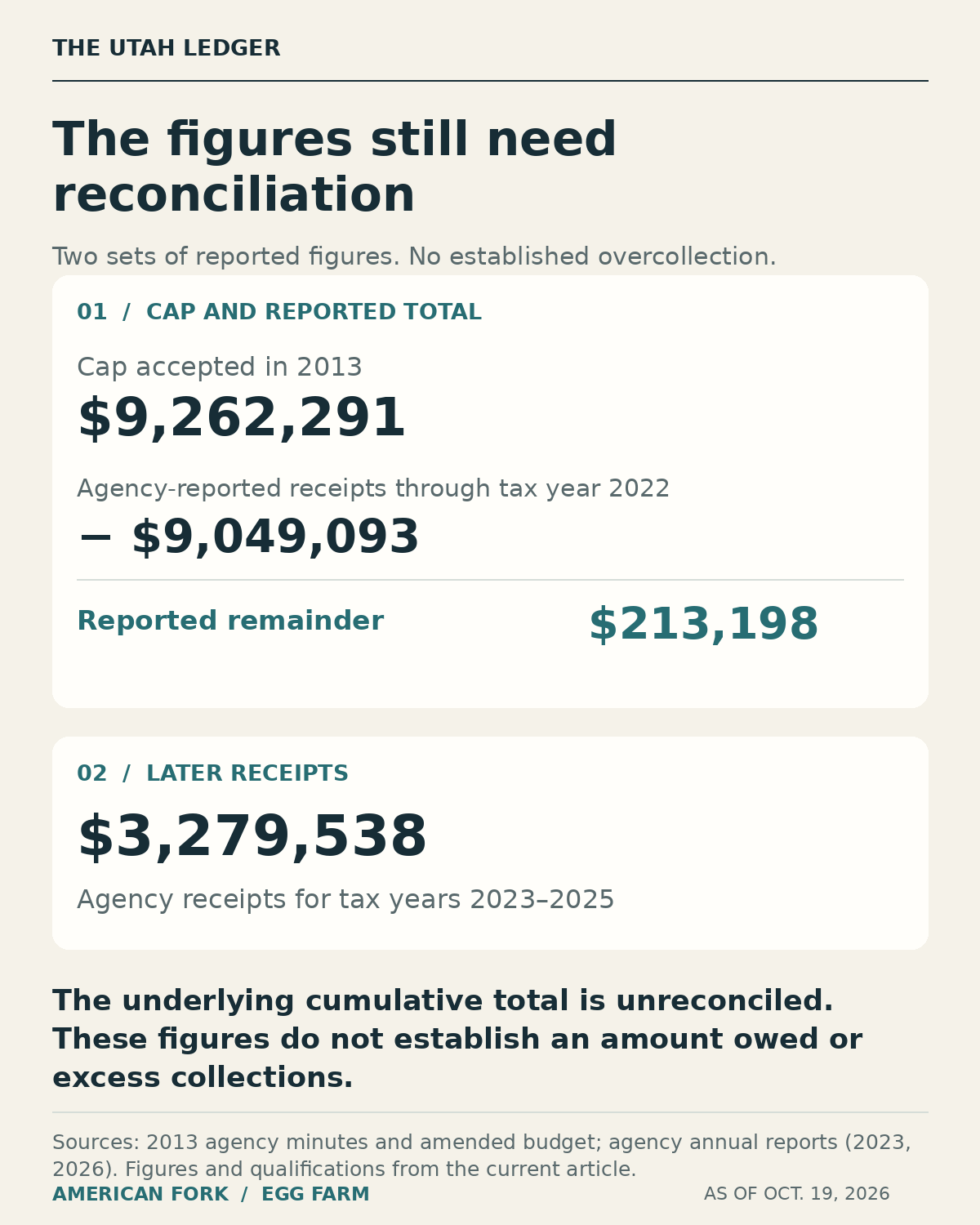
The agency's reported calculation is straightforward: a $9,262,291 cap minus $9,049,093 received through tax year 2022 leaves $213,198. The unresolved part is the $9,049,093 starting total. [6]
Adding the 2021 and 2022 receipts in later tables to the cumulative figure in the 2021 report gives $8,272,031, which is $777,062 less than the reported starting total. A separate $11,572,394 whole-area increment figure in the 2020 report reappears in the 2022 project table, and the 2023 table then adds agency-share receipts. That whole-area figure included a 25% share passed through to other taxing entities. The records reviewed do not explain how these figures produced the reported $9,049,093. [5][6][7][8][9]
For tax years 2023 through 2025, the 2026 report lists receipts of $1,020,659, $1,108,831 and $1,150,048, totaling $3,279,538. Subtracting the reported $213,198 remaining cap gives $3,066,340. Whether any of that difference must be returned depends on resolving the starting total and checking which receipts count toward the cap. The State Tax Commission's year-end 2025 schedule records $1,150,048.02 paid for Egg Farm, matching the agency's rounded figure for that year. [6][10]
Utah County's distribution schedules provide a different comparison. The Ledger's tally for 2015 through 2025 is $10,508,884.38, or $1,246,593.38 above the $9,262,291 cap. This tally excludes 2013 and 2014, for which schedules were not reviewed. The yearly schedules are not a certified ledger of amounts counted against the cap and do not show later refunds or adjustments. We need those missing records before we can say whether any money must be returned. [15][1]
The agency had previously forecast an early end. Its 2021 annual report projected reaching the cap with increment paid in fiscal 2024 for tax year 2023, using a 65% participation rate rather than 75%. It also said about $79,825 in delinquent increment remained outstanding. These forecasts do not reconcile the later reported totals. [5]
The documents do not resolve collection authority
State education officials also sought conditions in 2013. The State Board of Education's Oct. 4 minutes say its committee instructed the board's representative to oppose the agency's proposed amendment but support a new one with a 75/25 split, a Truth in Taxation requirement and a $9.4 million cap. The minutes also raised concern that excess money had been returned to taxing entities without Truth in Taxation. The agency's later October proposal used $9,262,291. [14][1]
More recent documents point in different directions. The June 11, 2024 packet includes an annual report listing no authorized funds for 2024, no project area funds for 2025 and no projected increment for 2024 through 2028. The proposed fiscal 2024–25 Egg Farm budget in the same packet lists $1,010,000 in revenue, including $800,000 of increment and $200,000 designated for housing. Neither document, on its own, states new authority to collect beyond the cumulative cap. [4]
The agency discussed a possible COVID-19 extension of collection periods in October 2021; the minutes do not record one being adopted. The state law that allowed those extensions keeps cumulative dollar caps in place. [12][13]
Separately, what the spending records show
The developer's reimbursement was a separate obligation. The 2021 report shows $4,288,509 repaid, including $1,042,565 in interest. The final $291,273 payment was made for tax year 2020 and listed among fiscal 2021 uses, leaving nothing owed. The records reviewed do not show later agency receipts going to the developer. [5]
The 2026 report's later expenditure rows divide each year's receipts roughly 5% to administration, 20% to housing and 75% to project expenses. Those rows are allocations, not a record of payments. [6]
Actual spending appears in the city's budgets. The fiscal 2025 actual column in the fiscal 2027 adopted budget reports $1,108,831 in increment and $145,748 in interest, with $251,739 spent: $32,367 for administration, $19,372 for road widening and a $200,000 transfer to the culinary water fund. The Egg Farm fund balance rose from $3,489,595 to $4,492,435. The previously reported $5.3 million was the budget's estimate for the end of fiscal 2026. [11]
The housing transfers to the water fund
The city's budgets report $2,391,106 transferred from the Egg Farm fund to the culinary water fund over five fiscal years: $1,628,069 in 2021, $204,965 in 2022, $202,470 in 2023, $155,602 in 2024 and $200,000 in 2025. The fiscal 2022 column lists $198,900 in housing increment revenue for that year. These transfers show where agency money went. To answer the cap question, we still need to know how receipts were counted. [17][7][20][21][11]
An April 20, 2021 work session presentation labels the $1,628,069 a low- and moderate-income housing reallocation, and the fiscal 2023 budget records it as an actual fiscal 2021 transfer to the water fund. The 2020 annual report said the city was preparing a resolution to reimburse itself for previously constructed affordable housing projects and related infrastructure. The 2021 report says the resolution was adopted and many projects had used federal grants requiring city matches, which the city intended to repay with housing increment. [16][17][18][5]
The agency board approved Resolution 2020-RA-04R, authorizing the use of housing allocation funds, 5-0 on Oct. 27, 2020. The minutes describe water-line improvements on qualifying projects funded largely with federal Community Development Block Grants. Chairman Brad Frost referred to eight phases of that work and said the housing money would go back to the culinary water enterprise fund. [19]
The Ledger has not obtained the executed 2020 resolution or the cost calculation showing which water-line expenses the transfers repaid. That is an unresolved spending question, separate from reconciling receipts against the cap. [19]
The records still needed
The Ledger requested Egg Farm's cap ledger, the 2013 committee resolution and fund disbursement records from American Fork on Oct. 15, and sent related questions to Utah County and Alpine School District. Utah County answered on Oct. 19. City Recorder Terilyn Lurker acknowledged the city's records request that day; substantive answers remain outstanding. Alpine School District has not responded as of Oct. 19.
Resolving the cap question requires four sets of records:
1. The executed 2013 taxing entity committee resolution and its complete final exhibits, establishing the approved terms. [2][3]
2. A reconciled ledger of agency-share increment counted toward the post-2012 cap, including the calculation behind $9,049,093 and all refunds, repayments and adjustments. [5][6][7][8][9][15]
3. Any Egg Farm early-termination or revised distribution instructions sent to or received by Utah County, with their effective dates.
4. Any adopted extension or amendment affecting the collection period or cap, including a COVID-19 extension if one was approved. The minutes reviewed establish discussion, not adoption. [12][13]
Updated Oct. 19, 2026: Reorganized this story around Utah County's response, clarified the different financial comparisons and corrected the ending to reflect the county's answer and American Fork's acknowledgment. The $3,066,340 and $1,246,593.38 figures compare reported totals with the cap; we still need the underlying ledger to determine whether any money must be returned. The cap-related search covered 113 of 116 indexed agency agenda and minute files from 2014 through 2026; three were inaccessible. The housing transfers show how money was used; the cap question depends on how receipts were counted.
Sources
- American Fork Redevelopment Agency · Oct. 22, 2013 minutes and proposed amended budget
- American Fork Redevelopment Agency · Dec. 10, 2013 minutes
- American Fork City · Jan. 26, 2016 strategic report
- American Fork City Redevelopment Agency · June 11, 2024 annual report and budget packet
- Redevelopment Agency of American Fork City · 2021 Annual Report (Utah County Auditor)
- American Fork Redevelopment Agency · 2026 Annual Report (June 23, 2026 agenda packet)
- American Fork Redevelopment Agency · 2023 annual report packet
- American Fork Redevelopment Agency · 2020 annual report packet
- American Fork Redevelopment Agency · 2022 annual report packet
- Utah State Tax Commission · Year-end 2025 project increment schedule
- American Fork City · FY2027 adopted budget, Egg Farm fund
- American Fork Redevelopment Agency · Oct. 26, 2021 minutes
- Utah Code 17C-1-416, version effective Aug. 31, 2020
- Utah State Board of Education · Oct. 4, 2013 minutes, p. 17
- Utah County Auditor · RDA distribution schedules for American Fork, 2015–2025
- American Fork City · April 20, 2021 work session packet, pp. 35–36
- American Fork City · FY2023 adopted budget
- Redevelopment Agency of American Fork City · 2020 Annual Report (state notice packet)
- American Fork Redevelopment Agency · Oct. 27, 2020 minutes
- American Fork City · FY2025 adopted budget, Egg Farm fund
- American Fork City · FY2026 adopted budget, Egg Farm fund
Reporting by The Utah Ledger from the public records above. AI-assisted, checked against those records.